Gambit: The Pyre Wars
About the Game
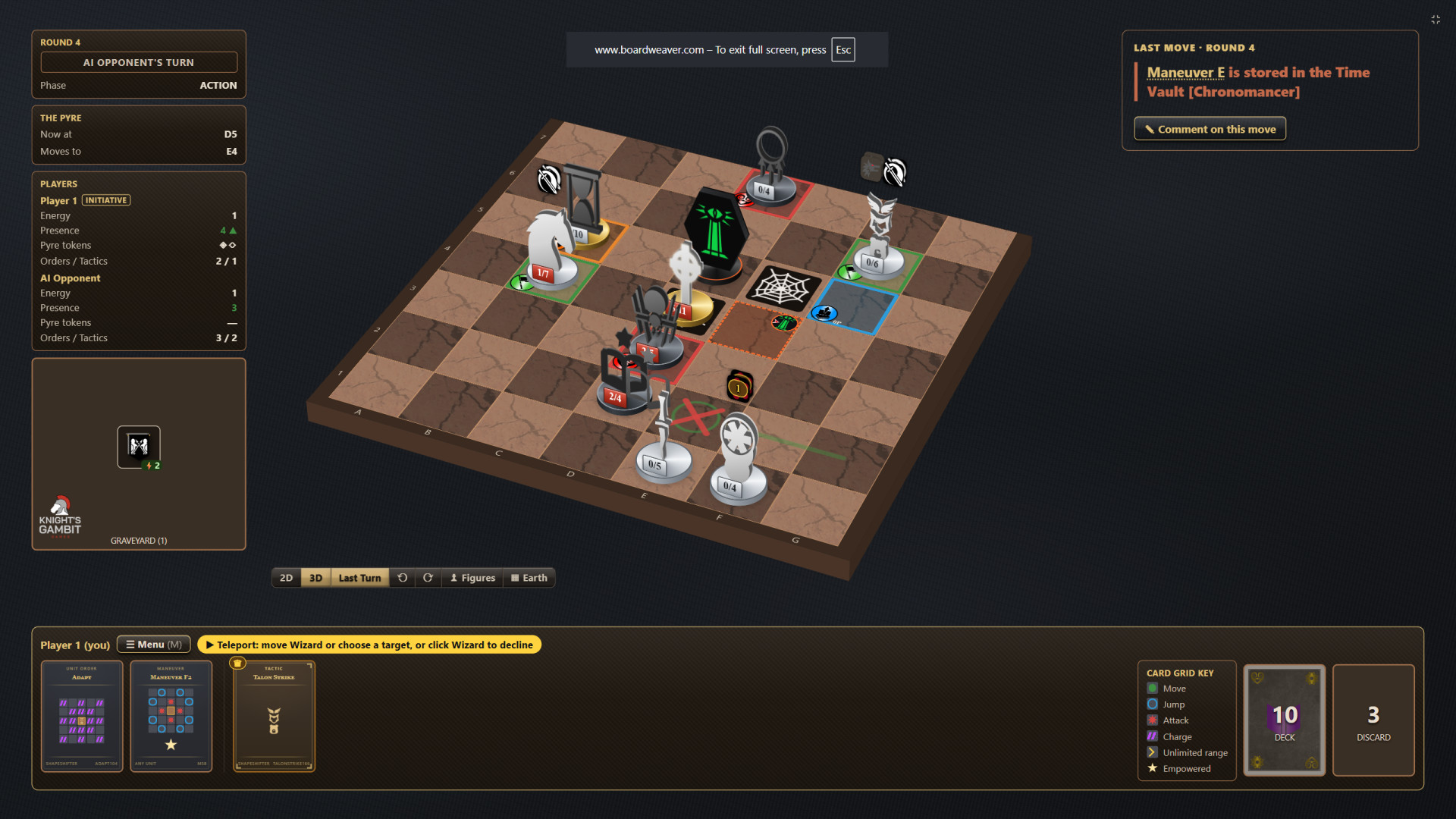
Gambit: The Pyre Wars is a two player, asymmetric card driven strategy game, and it's what I like to refer to as a “semi-abstract”. At a glance, it looks a lot like Chess, with pieces set upon a 7x7 board and movement is generally along ranks and files with the occasional “L” shaped knight-style move thrown in.
What Sets Gambit Apart
Unlike pure abstracts, you move your pieces in Gambit by playing cards. Some of these cards have movement grids on them that dictate how the piece can move and attack and may have some special text on them, while others are purely special text. In the game, there are two main types of cards – Orders and Tactics. Orders exist in your main deck and are available throughout the game, while Tactics are exceptionally strong cards that must be bought as the game progresses.
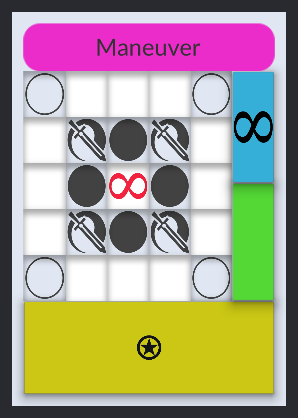
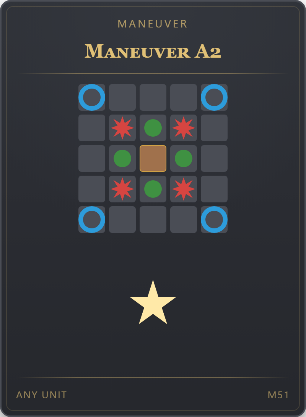
- Maneuvers are a type of Order that can be used to activate any of your pieces. All Maneuvers are a combination of moves and attacks, while a few allow jumps also, and in the standard game both players have the same nine Maneuvers in their main decks. The catch is that Maneuvers interact with the specific piece you activate with them, often triggering special abilities that are unique to each piece.
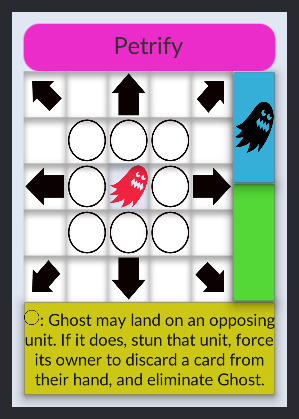
- Unit Orders are, as the name implies, Orders that are available in your main deck, but have unique effects. They can only be played to activate the piece they are connected to (e.g. you can only play Teleport to activate your Wizard) and each player has six different orders in their deck depending on the makeup of their army.
- Tactics are very strong and exist in a separate deck. Players start the game with one free tactic, and any additional tactics need to be purchased. Just like Unit Orders, each tactic is connected to a specific piece and can only be used to activate that piece, and, as a result, players' Tactics decks are completely different.
In addition to the cards, Gambit: The Pyre Wars has a few other elements that differentiate it from a typical abstract game:
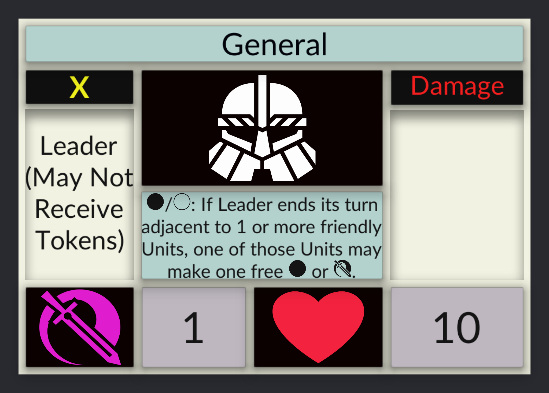
- Leaders – Each player has one Leader piece. Leaders have two roles in the game – the first, and most important, is that eliminating your opponent's Leader is one of the two ways to win the game. The second is that each Leader, while possessing unique innate abilities, order cards, and tactics, is primarily used to activate your other pieces on the board. What this means is that a Leader which is near your other pieces is very potent, while an isolated Leader is typically weak and ineffective.
- Round Based Play – Gambit is played across a series of rounds.
- Action Phase – This is when players activate their pieces to either attack their opponent's pieces or seize strategic control points on the board. Players alternate playing one card at a time, and the round ends when both players run out of cards in their hand.
- Pyre Control Phase – Here, players determine who has control of the Pyre based on how many troops they have placed on those control points and gain secondary benefits that are offered by any control points they occupy, such as additional card draws, gaining the initiative for the next round, or being awarded additional Energy to be used in the next phase. A player who has won control of the Pyre in three different rounds wins the game. This is complicated by the fact that the Pyre moves every round and has a different arrangement of control points around it as well.
- Strategy Phase – This is where players prepare for the next round. Players can use the Energy they have to re-recruit any pieces they lost and buy new Tactics that they can use to gain an advantage in the game.
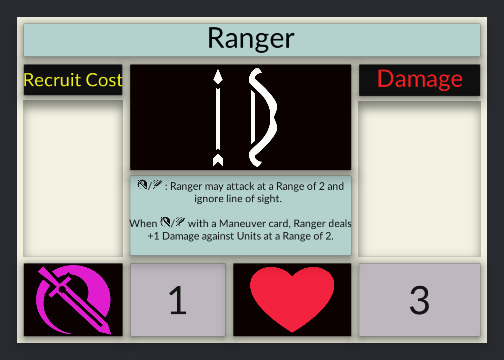
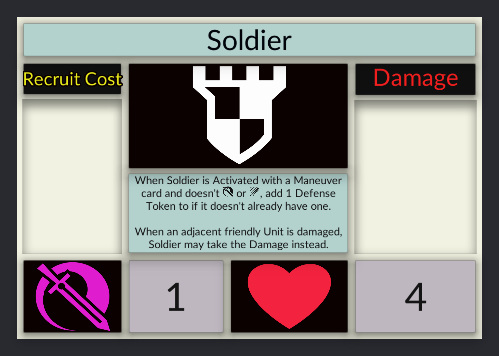
- Highly Thematic Abilities – Despite the abstract nature of how pieces move and attack on the board, each piece's innate abilities are designed to reflect the theme of the piece. Knights, after moving, get a free attack in the direction they moved, representing charging with a lance. Armored Soldiers can intercede when an adjacent unit is attacked and take the damage themselves. Assassins do additional damage when attacking an enemy unit from behind. All of the innate abilities are triggered by playing basic Maneuver cards to activate them, so a Maneuver played on a Knight will have a somewhat different effect than that same Maneuver does when played on a Soldier. The same is true for all the cards that are connected to a piece, both their Orders and Tactics. The driving design philosophy behind every card and ability is that a new player should look at it and think to themselves, “Yes, that makes sense.”
History of the Game
I started working on Gambit: The Pyre Wars back in 2020. It was my second attempt to create a game that had one overarching principle – “You cannot do a thing unless you control a piece that lets you do that thing.” While that sounds straightforward, the impetus behind that design decision was the many years I'd spent playing Magic: The Gathering. Magic was mechanically solid, of course, but the thematic inconsistency of the most effective decks was something I wanted to “fix”. I wanted a game where, if I wanted to cast a fireball, I had to have a piece in play that let you cast that fireball, and if you didn't have that piece on the field, you couldn't do it.
My very first attempt at that, Guilds of War, was pretty miserable. It was a deck builder, but bloated, unintuitive, and had a very shaky win condition. My next attempt, a “dudes on the map” style game, was better, but was still a slog to play through.
My next attempt, and I have no idea where this concept came from, was to merge the abstract nature of chess with the card play of Magic. This is an absolutely horrible description of Gambit, but it will do for now. The key concept I hit upon that defined how the game developed from there was that no piece would have any inherent movement or actions. Instead, you would play cards to activate your pieces, and those cards would determine where they could move and/or attack.
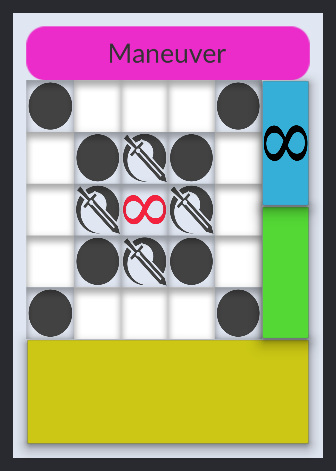
The next idea, and the one that really brought everything together, was that different pieces would interact with those basic cards differently. For example:
The next piece of the puzzle was leaders. Or, in the very early stage of the game, THE leader – the General.
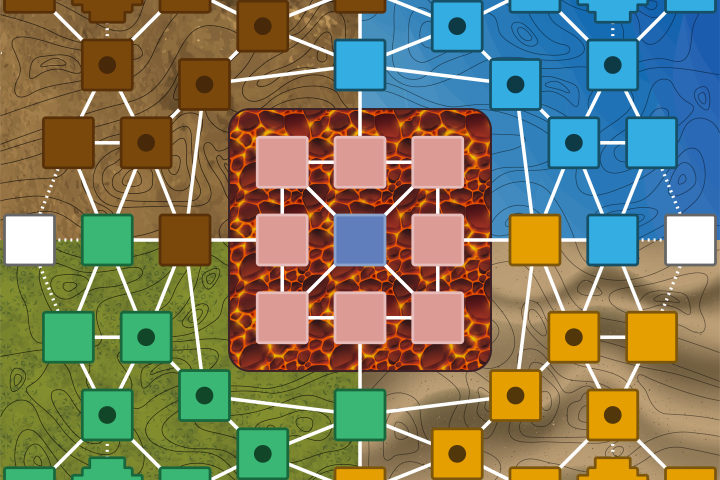
The game was starting to come together, but the win condition was problematic. Eliminating your opponent's leader could drag on, so I needed an alternate way to win – a way to press your advantage if your opponent was on the ropes but constantly moving their leader out of danger. I started with a “capture the flag” idea of moving a central piece back and forth across the board. This was better, but fiddly. After several attempts, I hit upon the idea of the Pyre. A centralized tower with control points that were arranged around it and placing your pieces on those points would help you win control of it. I iterated on that idea several times until the current incarnation was developed. It all came down to another deck of cards – the Pyre Deck.
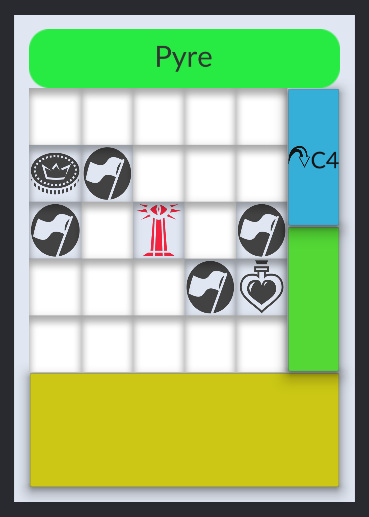
At the start of the game, the Pyre is in the exact center of the board, and there is an arrangement of control points around it, determined by a card draw. Those points would, at the end of the round, determine who won control of the Pyre for that round based on who had pieces in those spaces. Control points gave a combination of “presence” (total presence determined control of the Pyre for the round) and other benefits, such as healing and energy. What really made it work, though, was that little “C4” you see on the top right of the card. That determined where the Pyre would be located next round, but you wouldn't know the exact arrangement of control points until you drew next round's Pyre card. You get a little information about next round, but not the whole picture. After this, the game started to gel in a way that the play testers really appreciated. While there were obviously many changes to come, the core of the game has been consistent since that time, which was early 2021.
For the curious, here are several pictures of the game as it developed, both physical versions and the Tabletop Simulator version which is still available on Steam:
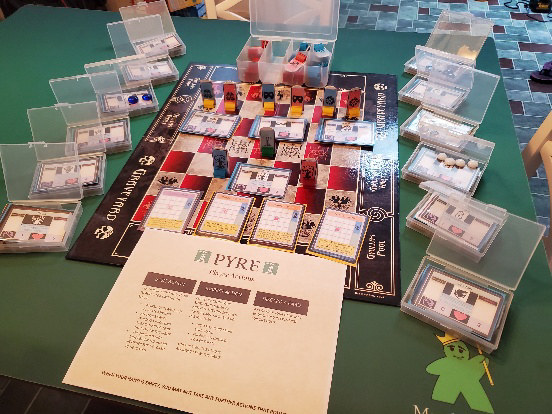
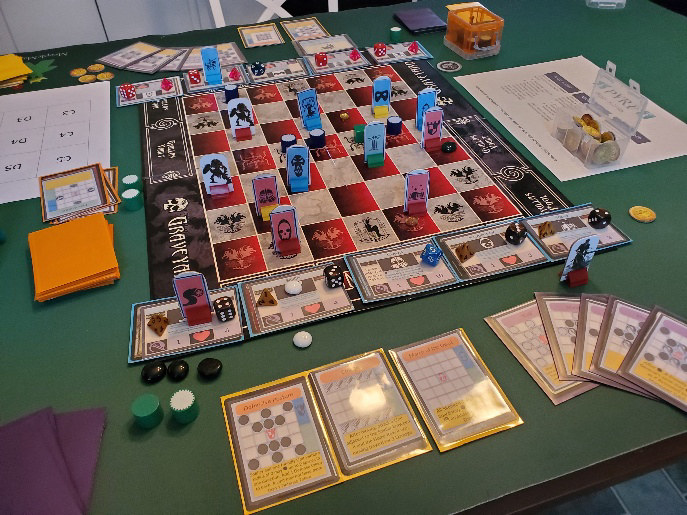
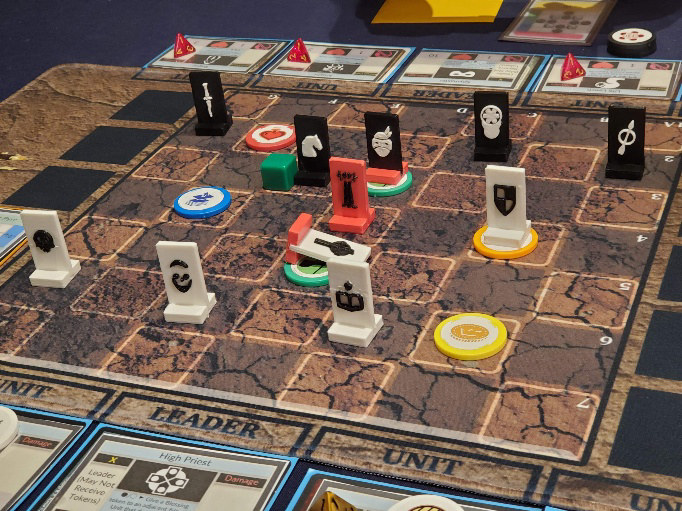
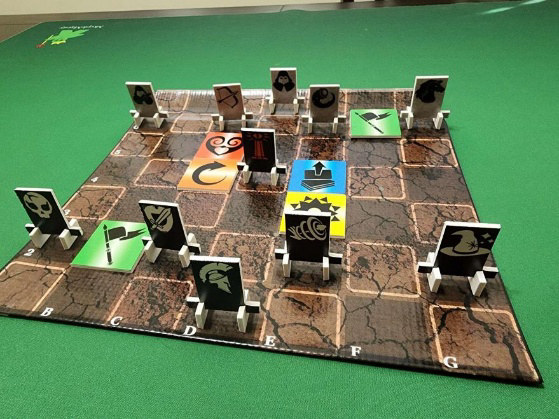
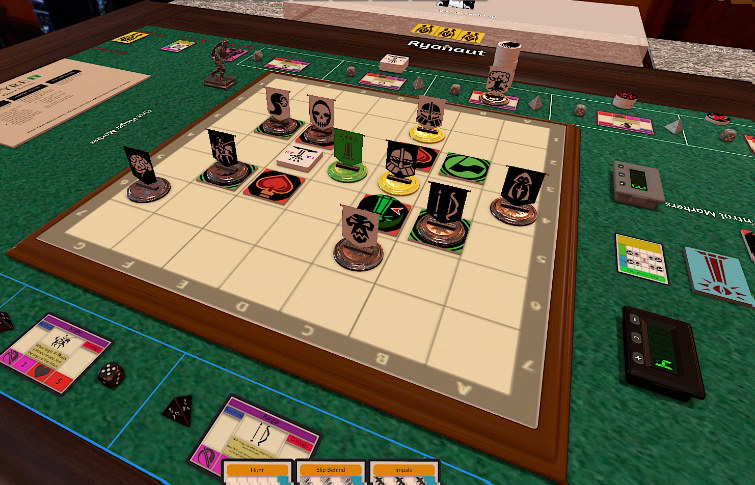
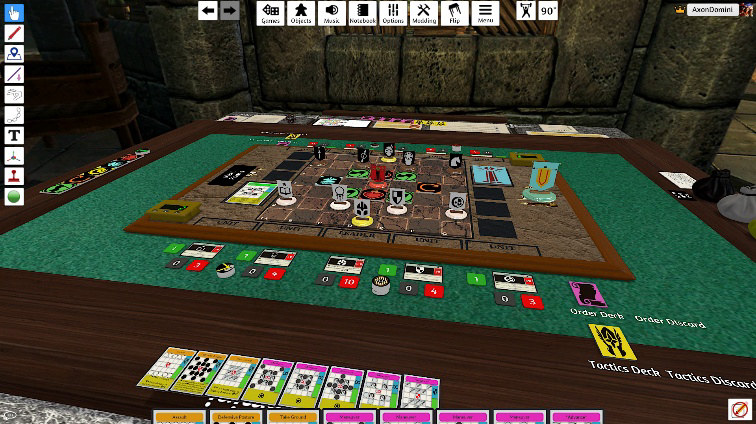
Eventually, in 2023, I sold the rights for Gambit to Slugfest Games, the publishers of the popular Red Dragon Inn series of games. Unfortunately, the economics of manufacturing and distributing physical board games changed drastically in 2024 and they eventually decided that they couldn't afford to move forward with it. After some discussion, they reverted the rights of the game back to me with terms that were extremely generous, even though my contract with them was more than a year away from expiring. They were excellent to work with and I have no regrets. I recommend them unreservedly to anyone who is looking to work with a board game publisher.
After a lot of thought, I finally decided to pursue publishing Gambit digitally. I have a working copy of the game that I've made available to a small team of testers with the goal of eventually releasing it on Steam in 2027. I've also engaged with an artist, Opiscopio, to remake all the unit icons and, eventually, the card frames (which are currently implemented with CSS rather than being hand drawn). Here's a sample of his work:


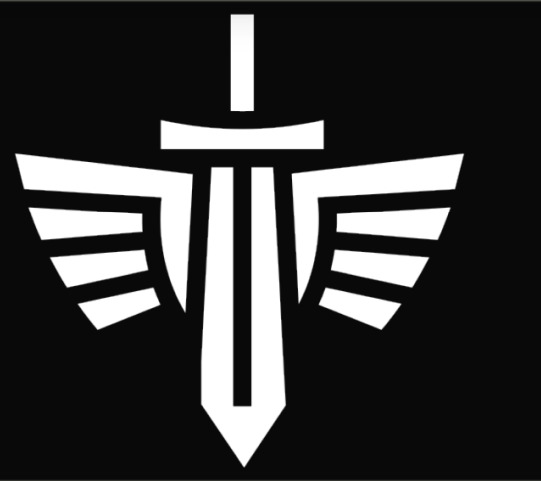

With over 40 pieces to design, along with other icons, he has his work cut out for him, but the impact on the feel of the game can't be overstated. I highly recommend him to anyone who is looking for an artist to bring their game to life. If you would like to contact Opiscopio he can be reached at opiscopio@gmail.com.
Gambit: The Pyre Wars – Digital Implementation
Digital Design Philosophy
When I decided to start working seriously on a digital version of Gambit, I had to make some decisions about what functionality and features I would include and how it would be presented. This came down to four main questions:
- Where would I get the art?
- How would I make the game accessible to new players?
- How would I take advantage of the possibilities offered by online play?
- How could I support and encourage a community to grow around the game?
Art
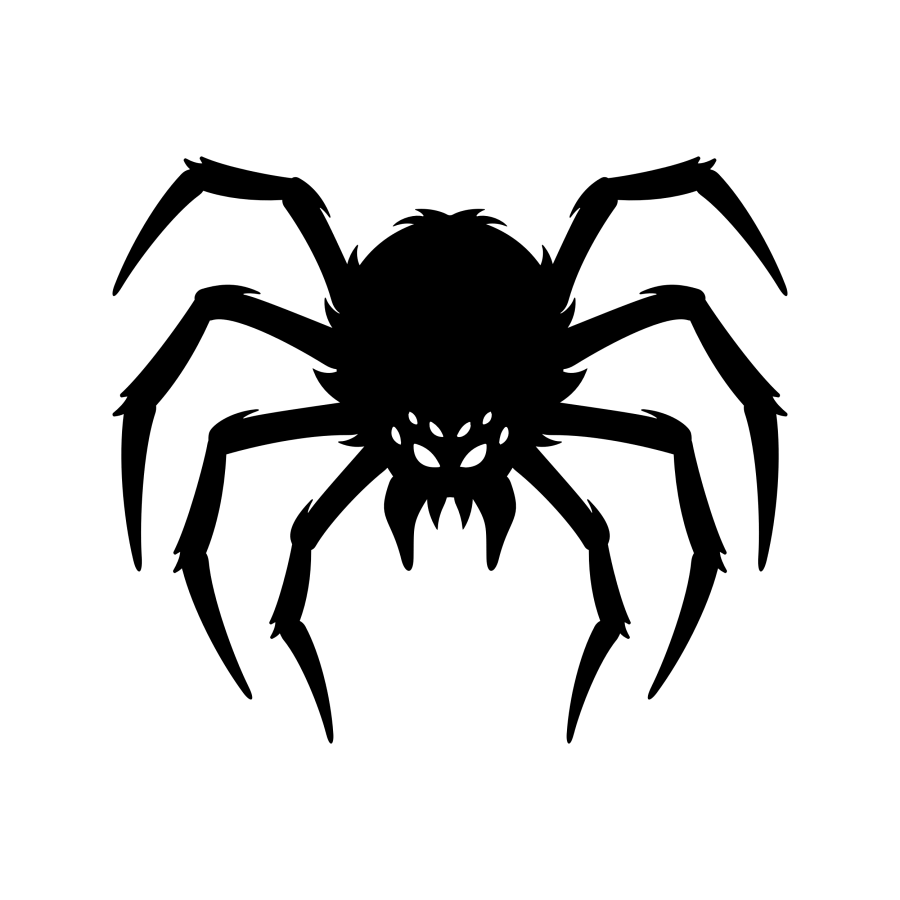
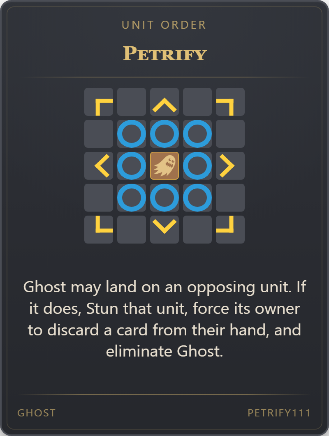
First, and hopefully obviously, generative AI art is not an option. Fortunately, I had done some work with an artist, Opiscopio, for my YouTube channel Tell Me About Your Game! We discussed Gambit and the kind of style I was looking for: not quite abstract, not quite representational. Each unit icon, which is where we've started, had to meet two strict criteria: it had to be easily and quickly identifiable on the board, and it needed to capture the theme of the unit, whether it was a Paladin, a Necromancer, or a Shapeshifter. So far, he's done an amazing job.


The next step will be the cards. Currently, they've all been created using cascading style sheets so each one can be quickly built and maintain a consistent style. This is fine for early alpha, or even beta, builds, but a final build will require hand designed card frames by a skilled artist. Opiscopio has experience in this area also, so I'm confident the game is in good hands here also, especially since he's been immersed in the look and feel of the game as a whole. For now, though, I'll continue with the CSS cards since they're a massive improvement over my own graphic design efforts.
Onboarding and Presentation
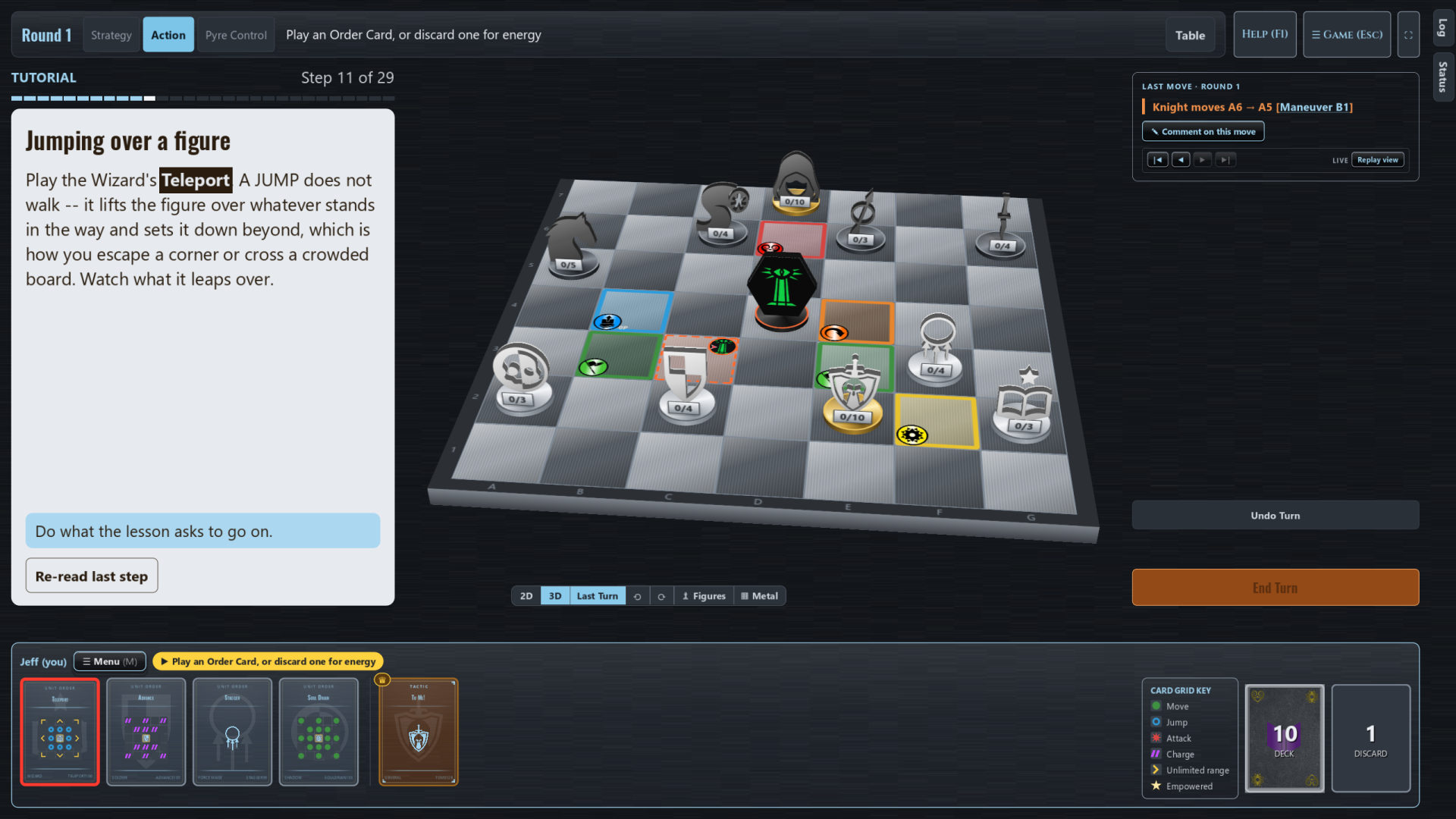
After deciding that Gambit's initial release would be digital, I decided to lean into the benefits that this brings. The first benefit is a fully scripted tutorial to teach players the game, with UI customized for that purpose.
The next benefit I wanted to make sure was fully taken advantage of was never leaving the player uncertain about what they had to choose next. Missing steps or not fully understanding choices in a physical board game, or a poorly designed digital board game, can be extremely frustrating. I wanted players to have the freedom to focus on the game's strategy, not struggle with the mechanics. To that end, an extraordinary amount of my time has been spent refining the UI so players don't have to search the screen for information or comb through the rule book. I want prompts to show up where players are already looking, and explain their options clearly.
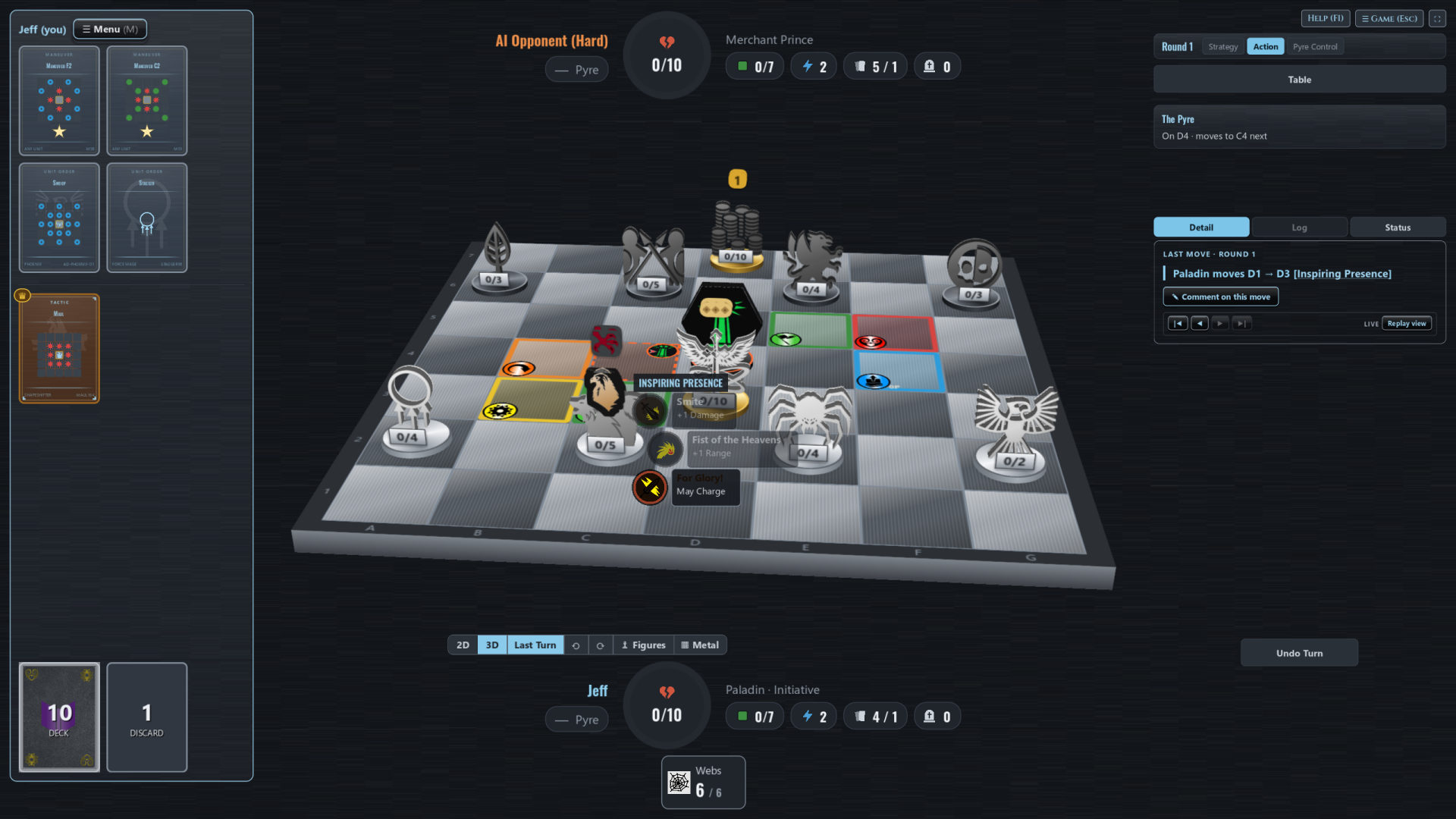
A lot of progress has been made over the past few months, but there are still areas I want to smooth out, and I expect further playtesting will expose even more UI areas that need to be improved.
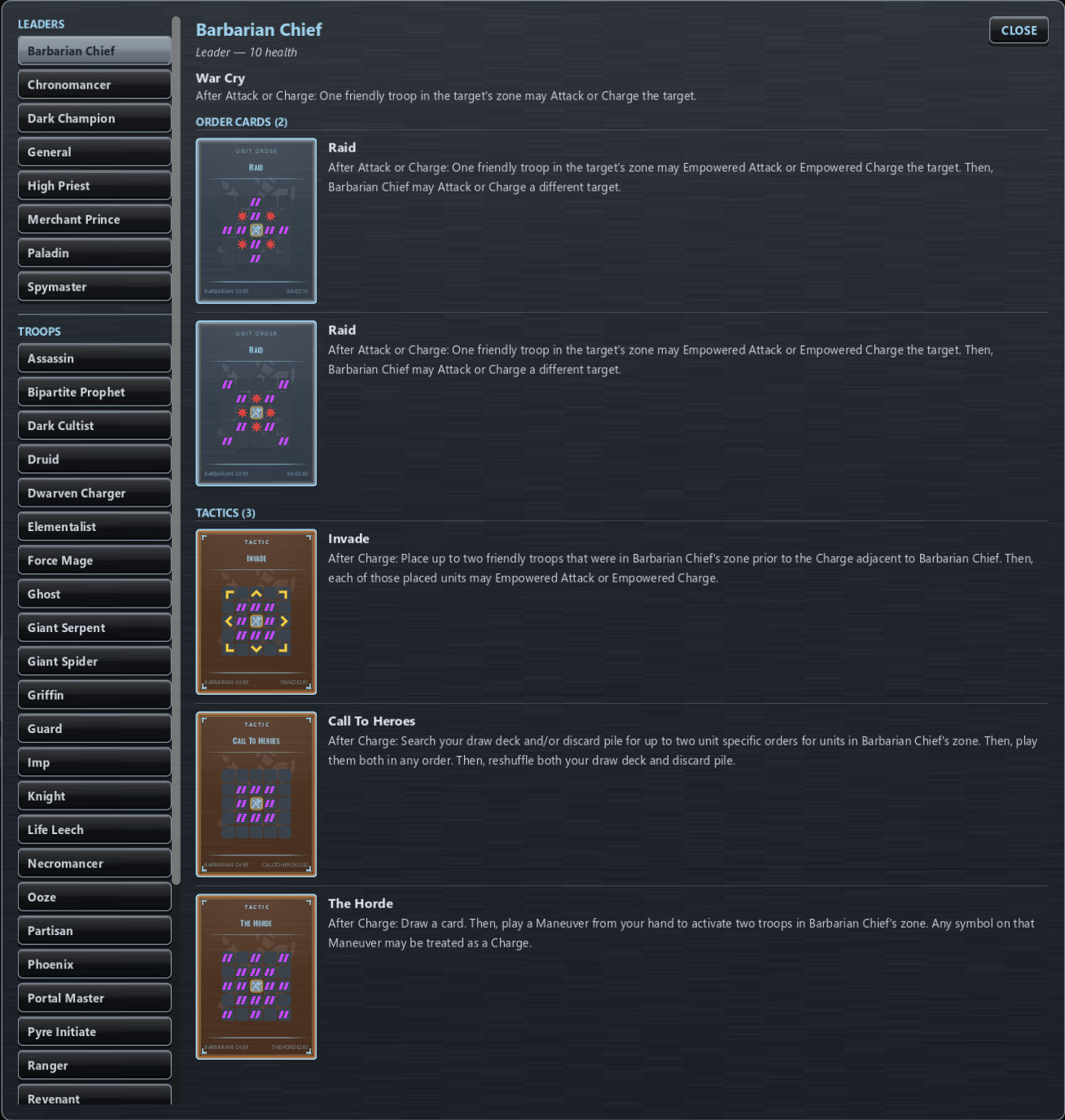
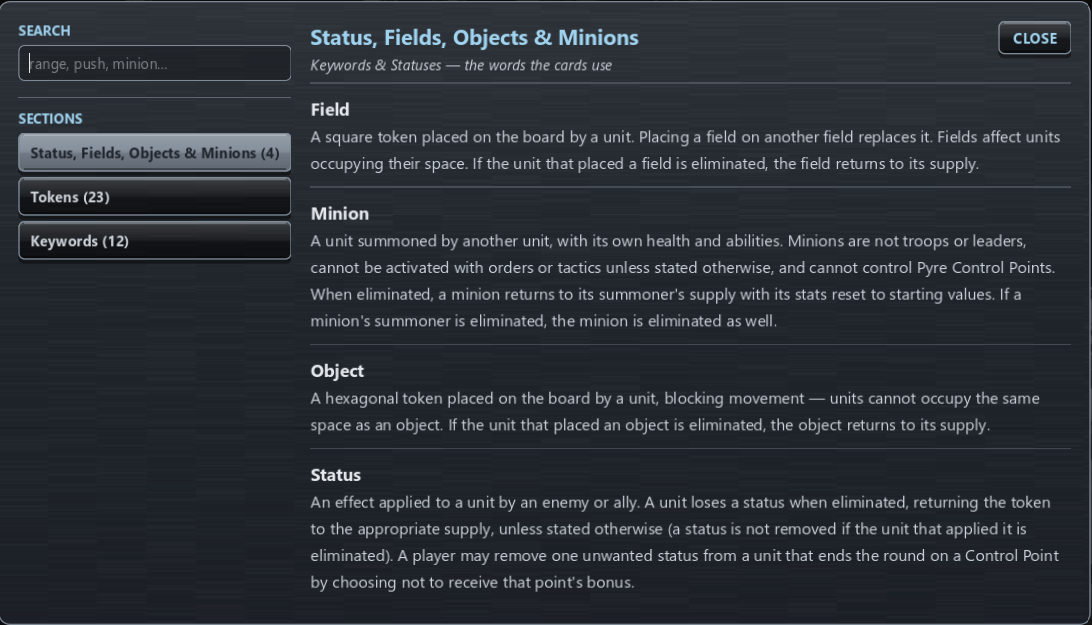
Finally, of course, I've implemented a comprehensive reference of all of the cards and the keywords that exist in the game. This, to me, is a bare minimum requirement for a digital board game, but I've seen more than a few that neglect to include this feature.
Online Play & Supporting Community
The main benefit of a digital board game, of course, is being able to find people to play with at any time. The bare minimum functionality for this is some sort of matchmaking service and in game chat. Chat is currently fully functional in the game, but there is no matchmaking yet, only direct connections through sharing IP addresses. Once the game is on Steam, its matchmaking and lobby support will help with this, but I'm exploring other options as well.
Beyond basic functionality, though, there are features I either plan to implement or have already implemented to support the growth of a community around the game. In addition to hosting a Discord server, here's a list of features that are either completed, in process, or in planning:
- Tournament Support Completed
- ELO ratings In Planning
- Custom Piece Design & Sharing Completed
- Sharing Annotated Game Logs for In Game Replays Completed
(Note: Completed doesn't mean that I'm finished working on that feature, just that it's functional at this time)
Of those features, the one I'm most excited to have is the ability for players to design their own pieces in the game. The in-game Unit Designer is very powerful and, if you build a unit using only the built in “blocks”, it will allow you use that piece in the game immediately, with all the rules for it enforced.
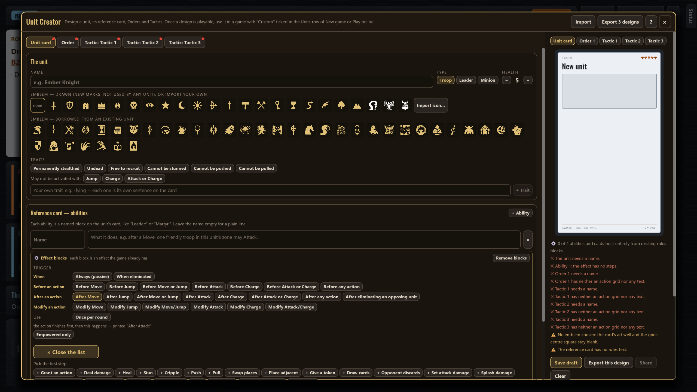
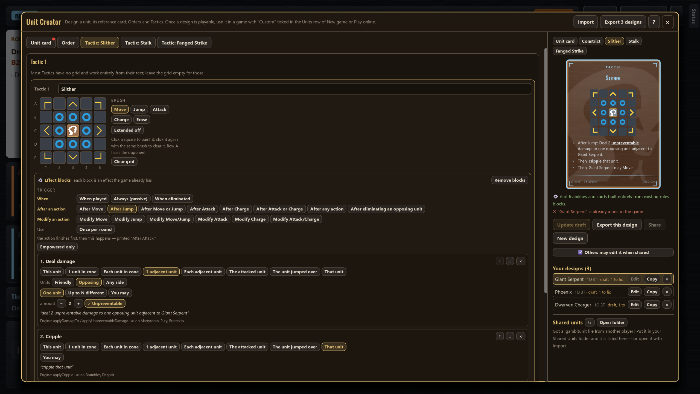
Several of the newer units that exist in the game now (Giant Snake, Phoenix, Barbarian Chief, etc.) were built completely using the game's built in unit designer – that's how versatile it is. And not only can you use them in your games, you can share them with others, either while connected in game or by sharing a single, small file that they can drop into their Shared Units folder and then import. Finally, when starting a game, the host can choose whether to allow custom units in the match.
While there's still a lot of work to do to get Gambit ready for an early access release, my goal is to have a demo ready for the Steam Next Fest scheduled for February, 2027 and set the early access release soon after. I have enough content ready for the base game and three full expansions, each expansion including one leader and four troops (enough for a full army for one player). Two more expansions have been started and should be ready in time for early access.
If you made it this far, thank you for your attention, and keep an eye on this space for updates!